
A little while ago I mentioned that the way different people choose to play Close Encounters can be interesting. In this post, we’ll look at some of the play styles I’ve commonly seen.
Continue reading “Play Styles in Close Encounters”Tag: Theory
Project Management with Colours
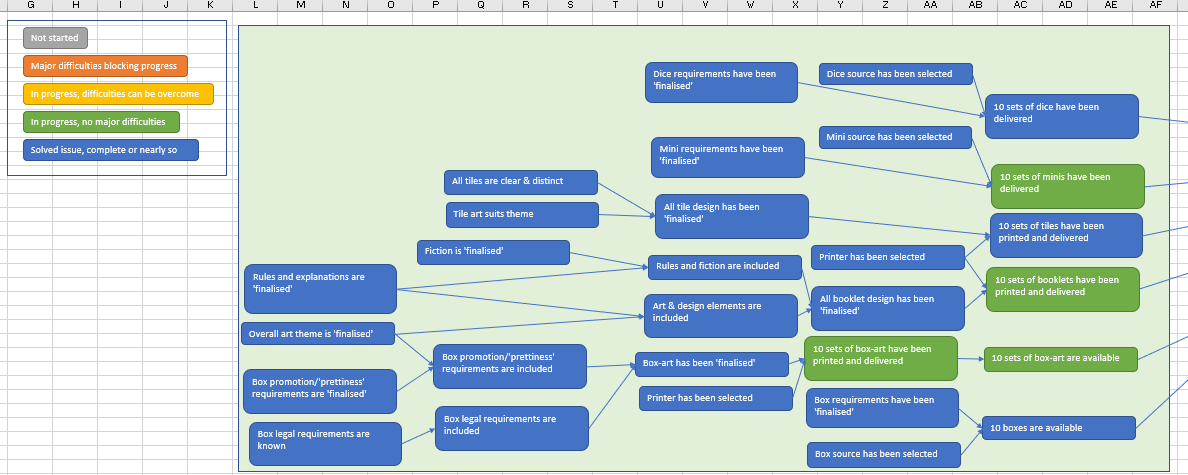
I know a lot of people manage projects in one way or another – even if you don’t do it for money, it’s the sort of thing that comes up a lot. Building a house, organising a camping holiday, writing a book proposal… they’re all projects, and they all go better if you manage them.
In my day job, project management is something I run into fairly often. Working on Close Encounters and its expansions is also a project, so when I started seriously developing it I knew I needed to get organised.
Continue reading “Project Management with Colours”The Advantages of Abstraction
When people play Close Encounters, one thing that gets comments is the close combat system. It’s fairly simple: each side totals up the bonuses they receive from participants, covering fire, and so on, and then they each roll a dice, add it to their total, and compare scores. The winner inflicts a casualty and forces any survivors to retreat.
This simplicity seems to be quite popular, and it speeds up the game. The most common alternative, where each figure involved makes its own die roll, would be an unwieldy mess in my opinion. That sort of thing might work well in games where there’s a strong focus on simulation, but for a fairly fast-paced game like Close Encounters it just wouldn’t be appropriate.
Instead, the close combat system relies on abstraction. I assume that the close combat will be a frantic melee with everyone in the tile taking part in it, doing their best both to strike and evade their opponents while everyone else does the same. Nobody is politely lining up to take turns here! That means we can consolidate the contributions of everyone involved into rough totals for Side A vs. Side B, and that abstraction of individual participation into a collective result is what makes the system work as well as it does.
Continue reading “The Advantages of Abstraction”The Agony of Choice
In the last few posts I’ve been talking about my plans for expansion packs for Close Encounters, and that’s where my development effort has been focused. Once I started getting to grips with it all, however, I found that there was quite a lot of stuff that could be included, and I started wondering if my plans for what goes into each expansion would cope with that.
Continue reading “The Agony of Choice”Working Within Limitations
When you engage in creative activities, you often hear things like “free your mind”, “think outside the box”, and so on. It’s important to hear those things – being free to come up with whatever is in your mind is arguably the essence of creativity, and you need to know it’s okay to pursue that.
However, once you’re on that path, it can be a useful exercise to choose some limits to work within, and see what you can do with that. That lets you focus your creativity on certain aspects, and makes you think about how to take advantage of what already exists. It also prevents the paralysis that can be caused by staring at a blank page and wondering how to fill it!
I ended up doing something similar during the design of Close Encounters, and I think the game ended up better as a result. Here’s how it all worked out.
Continue reading “Working Within Limitations”Alternative Expansion Splits
In the last post, I talked about my current thinking on how to split up the expansion packs for Close Encounters. I think the plan there would produce good results for both me and customers. However, I’m not married to the idea. Here are some of the alternatives which are lurking at the back of my mind.
Continue reading “Alternative Expansion Splits” Encounter Table Games